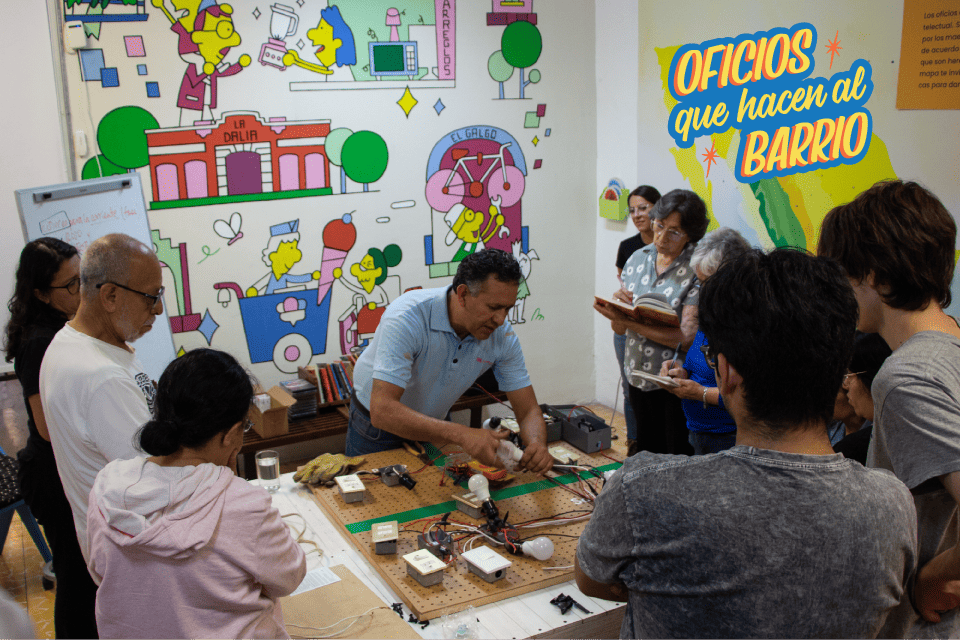
Trabajamos en colaboración con las comunidades escolares de Santa María la Ribera para desarrollar procesos educativos vinculados con el territorio, el medio ambiente y la creación colectiva. Estos programas se construyen en diálogo con docentes, estudiantes y equipos directivos, atendiendo a los intereses y necesidades específicas de cada comunidad.
A través de talleres, recorridos, proyectos artísticos y otras actividades, buscamos fortalecer el vínculo entre escuela y entorno, promoviendo aprendizajes significativos que conecten el aula con la experiencia directa del barrio y sus problemáticas.
Su propia casa.
Earth Nook in República de Cuba primary school
Teacher Ariadna Monroy, who gives 3rd grade in the República de Cuba primary school, has hosted the Earth Nook in her classroom since January 2022. In other months she has incorporated contents from this fun moving library to reinforce her lessons, particularly in reading comprehension and mathematical skills. Furthermore, she has hosted and led activities programmed by Casa Gallina, such as workshops, presentations of animations and guided tours of the Casa.

The treasure of languages: a map of our diversity
During this school year, the students of the Pedagogy degree program at FES Acatlán implemented the workshop for upper primary school “The treasure of languages: a map of our diversity”. This project was advised in collaboration with teacher Laura Cruz and the education team of Casa Gallina.
In the first months of the year, the students and facilitators developed the framework for a teacher's guide focused on addressing linguistic diversity in classrooms, as well as the prototype of a sample workshop. The manual focused on providing historical context, proposing a critical reading on linguistic rights, and establishing direct links with the programs and materials of the New Mexican School (NEM) corresponding to each school grade.
Furthermore, the workshop implemented collective mapping methodologies and logbooks in order to address mother tongues and indigenous languages from the local context. Through these tools, the children explored their surroundings, interviewed family members and neighbors, and fostered a deep classroom conversation about identity, rights, and the cultural richness that resides in their own neighborhood.
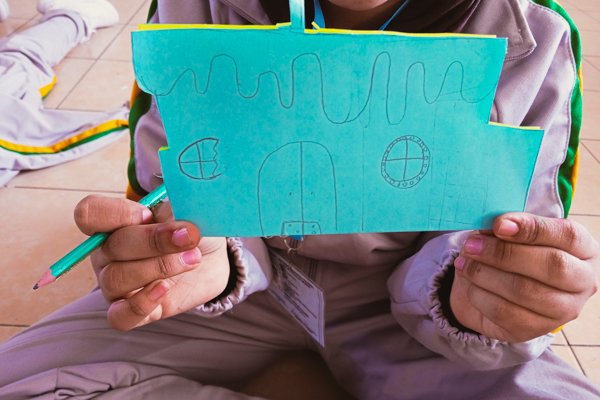
Workshop: Book Architects
To promote reading among first-year students, and using the book Home, by Carson Ellis as a reference; reading comprehension activities and artistic exercises to explore the diversity of households were carried out. Among the students, a series of fanzines was produced, which between reality and fantasy captured each adolescent's idea of home.
Our School is also our Neighborhood: Prototype Laboratory
This activity focused on an open call for members of the neighborhood community to design educational activities and/or infrastructure projects to run parallel to the classes taught at basic level in public schools. The call was open to anyone who had any idea with the potential to become a project or program to support teachers.
The program allowed four of the ideas proposed by the participants to become projects to be implemented in school clubs. Those who participated in this laboratory are in a process of articulation with school authorities and adjustments with teachers to attach their initiatives to the clubs within the curricular autonomy program in the 2019–2020 school cycle.
Mural by Perla Krauze at the República de Cuba School
Over the course of a semester, artist Perla Krauze conducted sessions with sixth-grade classes at the República de Cuba school. Krauze worked with the children to foster an appreciation for the school's own history and memory; in the early 20th century, it was known as "the milpa school" because it was surrounded by crop fields. The participating children created drawings and collages using various fragments to represent the milpa. Krauze incorporated these ideas into the design of a 14-square-meter mural made from materials commonly found on local building facades: cantera stone, recinto volcanic rock, and ceramic tiles.
Nature is Knowledge, I Build Myself With It
A process of dialogue between students and artist Sofía Echeverri where, through knowledge of the flora and fauna that inhabit the Valley of Mexico, each student created a character named according to its attributes. Following this exchange process, the students shared the work they had done with the rest of the school community in a display where they socialized their creative development and the characters’ traits.
This process is the first phase to create a piece that will be mounted permanently in the school’s grounds.
SIlvestre sonora (Feral Sounds)
Artistic intervention by Circe Irasema in middle school No. 4, Moisés Sáenz
The installation of the piece Feral Sounds was completed. It was developed by artist Circe Irasema in conjunction with a group of students from public middle school No. 4, Moisés Sáenz. The piece will remain permanently installed in one of the school's interior gardens, to be used and enjoyed by the entire school community. The piece is about the fauna that lives in the Valley of Mexico and their onomatopoeic sounds; it aims to encourage the youngsters to listen to the sounds made by local fauna in the building’s gardens.
Workshop: Literary Shoots
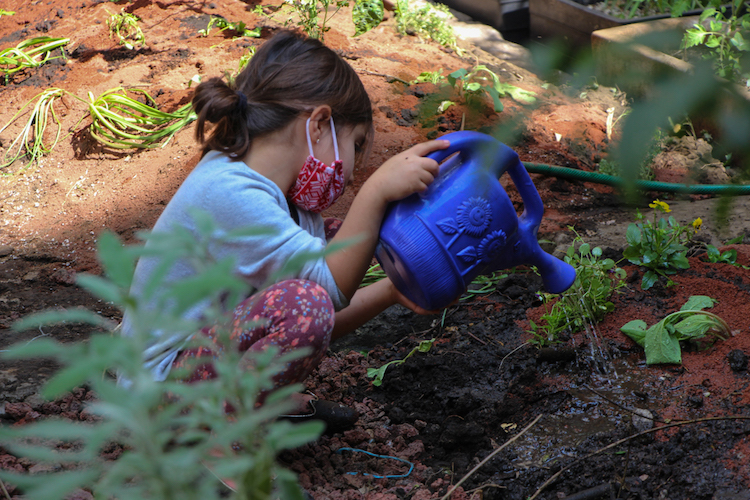
A workshop consisting of six sessions where participants worked on possible linkages between children's literature and direct contact with nature. To do so they resorted to a collection of specialized literature and worked directly with plants and the sculpture Feral Sounds by Circe Irasema which had already been installed in the school gardens.